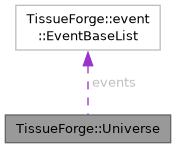
The universe is a top level singleton object, and is automatically initialized when the simulator loads. The universe is a representation of the physical universe that we are simulating, and is the repository for all physical object representations.
More...
|
| static FVector3 | dim () |
| | Gets the dimensions of the universe.
|
| |
| static FloatP_t | volume () |
| | Gets the volume of the universe.
|
| |
|
static std::string | getName () |
| | Get the name of the model / script.
|
| |
| static FMatrix3 * | virial (FVector3 *origin=NULL, FloatP_t *radius=NULL, std::vector< ParticleType * > *types=NULL) |
| | Computes the virial tensor for the either the entire simulation domain, or a specific local virial tensor at a location and radius. Optionally can accept a list of particle types to restrict the virial calculation for specify types.
|
| |
| static FVector3 | getCenter () |
| |
| static HRESULT | step (const FloatP_t &until=0, const FloatP_t &dt=0) |
| | Performs a single time step dt of the universe if no arguments are given. Optionally runs until until, and can use a different timestep of dt.
|
| |
|
static HRESULT | stop () |
| | Stops the universe time evolution. This essentially freezes the universe, everything remains the same, except time no longer moves forward.
|
| |
|
static HRESULT | start () |
| | Starts the universe time evolution, and advanced the universe forward by timesteps in dt. All methods to build and manipulate universe objects are valid whether the universe time evolution is running or stopped.
|
| |
|
static HRESULT | reset () |
| |
|
static Universe * | get () |
| |
|
static ParticleList | particles () |
| | Gets all particles in the universe.
|
| |
|
static std::vector< int32_t > | particleIds () |
| | Gets all particles in the universe.
|
| |
|
static void | resetSpecies () |
| | Reset all species in all particles.
|
| |
| static std::vector< std::vector< std::vector< ParticleList > > > | grid (iVector3 shape) |
| | Gets a three-dimesional array of particle lists, of all the particles in the system.
|
| |
|
static std::vector< BondHandle > | bonds () |
| | Get all bonds in the universe.
|
| |
|
static std::vector< AngleHandle > | angles () |
| | Get all angles in the universe.
|
| |
|
static std::vector< DihedralHandle > | dihedrals () |
| | Get all dihedrals in the universe.
|
| |
| static FloatP_t | getTemperature () |
| | Get the universe temperature.
|
| |
|
static FloatP_t | getTime () |
| | Get the current time.
|
| |
|
static FloatP_t | getDt () |
| | Get the period of a time step.
|
| |
|
static event::EventList * | getEventList () |
| |
| static BoundaryConditions * | getBoundaryConditions () |
| |
|
static FloatP_t | getKineticEnergy () |
| | Get the current system kinetic energy.
|
| |
|
static int | getNumTypes () |
| | Get the current number of registered particle types.
|
| |
|
static FloatP_t | getCutoff () |
| | Get the global interaction cutoff distance.
|
| |
|
static unsigned int | getNumFluxSteps () |
| | Get the number of flux steps per simulation step.
|
| |
The universe is a top level singleton object, and is automatically initialized when the simulator loads. The universe is a representation of the physical universe that we are simulating, and is the repository for all physical object representations.
All properties and methods on the universe are static, and you never actually instantiate a universe.
Universe has a variety of properties such as boundary conditions, and stores all the physical objects such as particles, bonds, potentials, etc.
| static FloatP_t TissueForge::Universe::getTemperature |
( |
| ) |
|
|
static |
Get the universe temperature.
The universe can be run with, or without a thermostat. With a thermostat, getting / setting the temperature changes the temperature that the thermostat will try to keep the universe at. When the universe is run without a thermostat, reading the temperature returns the computed universe temp, but attempting to set the temperature yields an error.