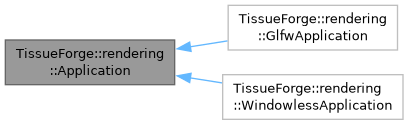
Public Member Functions | |
| virtual HRESULT | pollEvents ()=0 |
| virtual HRESULT | waitEvents ()=0 |
| virtual HRESULT | waitEventsTimeout (double timeout)=0 |
| virtual HRESULT | postEmptyEvent ()=0 |
| virtual HRESULT | mainLoopIteration (double timeout)=0 |
| virtual HRESULT | setSwapInterval (int si)=0 |
| virtual struct GlfwWindow * | getWindow ()=0 |
| virtual int | windowAttribute (WindowAttributes attr)=0 |
| virtual HRESULT | setWindowAttribute (WindowAttributes attr, int val)=0 |
| virtual HRESULT | createContext (const Simulator::Config &conf)=0 |
| virtual UniverseRenderer * | getRenderer ()=0 |
| virtual HRESULT | redraw ()=0 |
| virtual HRESULT | run (double et) |
| virtual HRESULT | close ()=0 |
| virtual HRESULT | destroy ()=0 |
| virtual HRESULT | show ()=0 |
| virtual HRESULT | simulationStep () |
| virtual HRESULT | messageLoop (double et)=0 |
| virtual Magnum::GL::AbstractFramebuffer & | framebuffer ()=0 |
| virtual bool | contextMakeCurrent ()=0 |
| virtual bool | contextHasCurrent ()=0 |
| virtual bool | contextRelease ()=0 |
Public Attributes | |
| std::vector< GlfwWindow * > | windows |
Protected Attributes | |
| bool | _dynamicBoundary = 1 |
| Magnum::Float | _boundaryOffset = 0.0f |
| int | currentStep = 0 |
Member Function Documentation
◆ pollEvents()
|
pure virtual |
This function processes only those events that are already in the event queue and then returns immediately. Processing events will cause the window and input callbacks associated with those events to be called.
On some platforms, a window move, resize or menu operation will cause event processing to block. This is due to how event processing is designed on those platforms. You can use the window refresh callback to redraw the contents of your window when necessary during such operations.
Implemented in TissueForge::rendering::GlfwApplication, and TissueForge::rendering::WindowlessApplication.
◆ postEmptyEvent()
|
pure virtual |
This function posts an empty event from the current thread to the event queue, causing waitEvents or waitEventsTimeout to return.
Implemented in TissueForge::rendering::GlfwApplication, and TissueForge::rendering::WindowlessApplication.
◆ redraw()
|
pure virtual |
post a re-draw event, to tell the renderer that it should re-draw
Implemented in TissueForge::rendering::GlfwApplication, and TissueForge::rendering::WindowlessApplication.
◆ waitEvents()
|
pure virtual |
This function puts the calling thread to sleep until at least one event is available in the event queue. Once one or more events are available, it behaves exactly like glfwPollEvents, i.e. the events in the queue are processed and the function then returns immediately. Processing events will cause the window and input callbacks associated with those events to be called.
Since not all events are associated with callbacks, this function may return without a callback having been called even if you are monitoring all callbacks.
On some platforms, a window move, resize or menu operation will cause event processing to block. This is due to how event processing is designed on those platforms. You can use the window refresh callback to redraw the contents of your window when necessary during such operations.
Implemented in TissueForge::rendering::GlfwApplication, and TissueForge::rendering::WindowlessApplication.
◆ waitEventsTimeout()
|
pure virtual |
This function puts the calling thread to sleep until at least one event is available in the event queue, or until the specified timeout is reached. If one or more events are available, it behaves exactly like pollEvents, i.e. the events in the queue are processed and the function then returns immediately. Processing events will cause the window and input callbacks associated with those events to be called.
The timeout value must be a positive finite number. Since not all events are associated with callbacks, this function may return without a callback having been called even if you are monitoring all callbacks.
On some platforms, a window move, resize or menu operation will cause event processing to block. This is due to how event processing is designed on those platforms. You can use the window refresh callback to redraw the contents of your window when necessary during such operations.
Implemented in TissueForge::rendering::GlfwApplication, and TissueForge::rendering::WindowlessApplication.
Member Data Documentation
◆ windows
| std::vector<GlfwWindow*> TissueForge::rendering::Application::windows |
list of windows.
The documentation for this struct was generated from the following file:
- source/rendering/tfApplication.h