Loading...
Searching...
No Matches
TissueForge::BoundaryCondition Struct Reference
A condition on a boundary of the universe. More...
#include <tfBoundaryConditions.h>
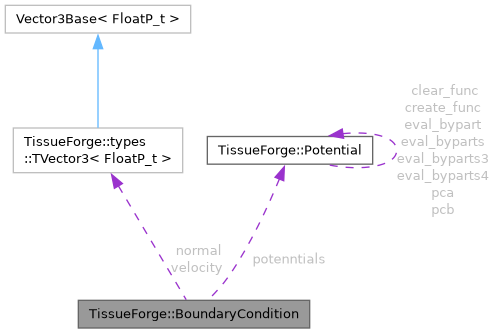
Collaboration diagram for TissueForge::BoundaryCondition:
Public Member Functions | |
| void | set_potential (struct ParticleType *ptype, struct Potential *pot) |
| std::string | kindStr () const |
| std::string | str (bool show_name) const |
| unsigned | init (const unsigned &kind) |
| unsigned | init (const FVector3 &velocity, const FPTYPE *restore=NULL) |
| unsigned | init (const std::unordered_map< std::string, unsigned int > vals, const std::unordered_map< std::string, FVector3 > vels, const std::unordered_map< std::string, FPTYPE > restores) |
Public Attributes | |
| BoundaryConditionKind | kind |
| int | id |
| FVector3 | velocity |
| the velocity on the boundary | |
| FPTYPE | restore |
| restoring percent. | |
| const char * | name |
| name of the boundary | |
| FVector3 | normal |
| vector normal to the boundary | |
| struct Potential ** | potenntials |
| FPTYPE | radius |
Detailed Description
A condition on a boundary of the universe.
Member Function Documentation
◆ set_potential()
| void TissueForge::BoundaryCondition::set_potential | ( | struct ParticleType * | ptype, |
| struct Potential * | pot ) |
sets the potential for the given particle type.
Member Data Documentation
◆ potenntials
| struct Potential** TissueForge::BoundaryCondition::potenntials |
pointer to offset in main array allocated in BoundaryConditions.
◆ restore
| FPTYPE TissueForge::BoundaryCondition::restore |
restoring percent.
When objects hit this boundary, they get reflected back at restore percent, so if restore is 0.5, and object hitting the boundary at 3 length / time recoils with a velocity of 1.5 lengths / time.
The documentation for this struct was generated from the following file:
- source/mdcore/include/tfBoundaryConditions.h