Loading...
Searching...
No Matches
tf_bindPy.h File Reference
#include "tf_py.h"#include "tfBoundaryConditionsPy.h"#include "tfForcePy.h"#include "tfPotentialPy.h"#include <tfParticle.h>
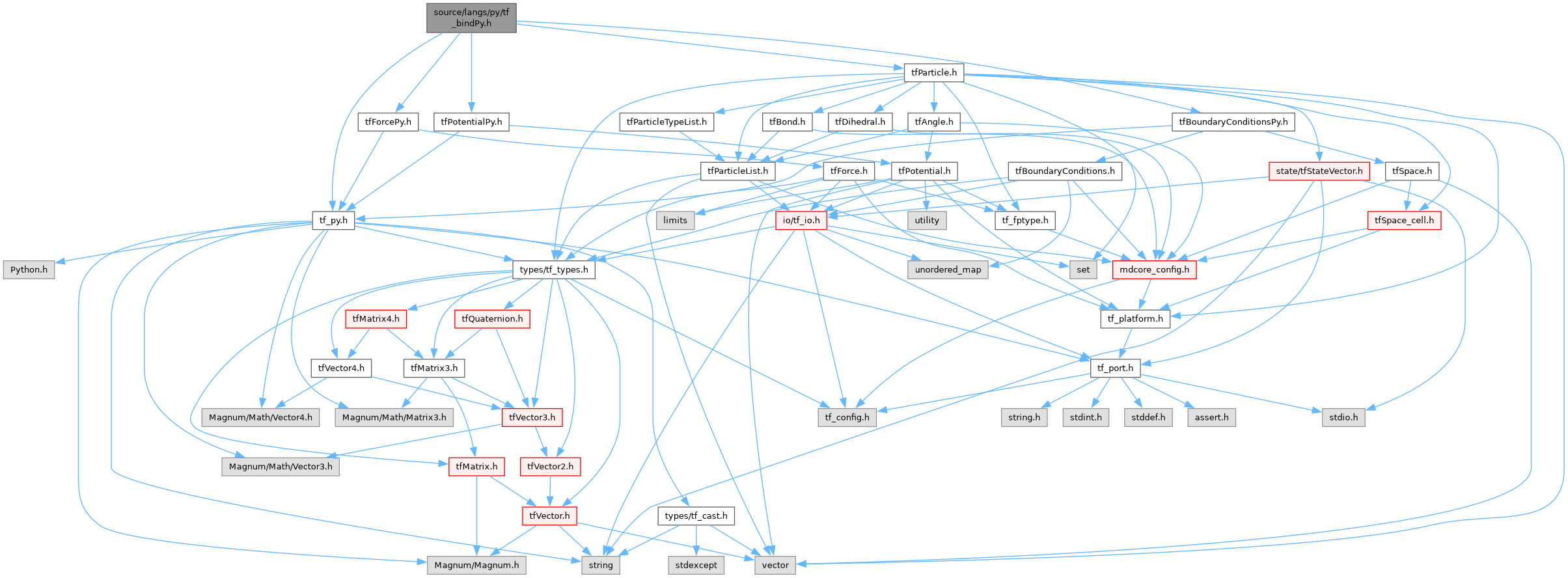
Include dependency graph for tf_bindPy.h:
Go to the source code of this file.
Namespaces | |
| namespace | TissueForge |
| Include Python header, disable linking to pythonX_d.lib on Windows in debug mode. | |
| namespace | TissueForge::py |
| Tissue Forge Python language support. | |
Functions | |
| HRESULT | TissueForge::py::particles (Potential *p, Particle *a, Particle *b) |
| Bind a potential to a pair of particles. | |
| HRESULT | TissueForge::py::types (Potential *p, ParticleType *a, ParticleType *b, bool bound=false) |
| Bind a potential to a pair of particle types. | |
| HRESULT | TissueForge::py::boundary_conditions (Potential *p, ParticleType *t) |
| Bind a potential to a pair of particle type and all boundary conditions. | |
| HRESULT | TissueForge::py::boundary_condition (Potential *p, BoundaryCondition *bc, ParticleType *t) |
| Bind a potential to a pair of particle type and a boundary conditions. | |
| HRESULT | TissueForge::py::force (Force *force, ParticleType *a_type) |
| Bind a force to a particle type. | |
| HRESULT | TissueForge::py::force (Force *force, ParticleType *a_type, const std::string &coupling_symbol) |
| Bind a force to a particle type with magnitude proportional to a species amount. | |
| std::vector< BondHandle > | TissueForge::py::_bondsPy (Potential *potential, ParticleList *particles, const FloatP_t &cutoff, std::vector< std::pair< ParticleType *, ParticleType * > * > *pairs=NULL, FloatP_t *half_life=NULL, FloatP_t *bond_energy=NULL, uint32_t flags=0) |
| Create bonds for a set of pairs of particles. | |
| std::vector< BondHandle > | TissueForge::py::_spherePy (ParticleList *particles, Potential *potential, const int &n, FVector3 *center=NULL, const FloatP_t &radius=1.0, FloatP_t *phi0=NULL, FloatP_t *phi1=NULL, ParticleType *type=NULL) |