Loading...
Searching...
No Matches
tfPotential.h File Reference
#include "tf_platform.h"#include "tf_fptype.h"#include <io/tf_io.h>#include <limits>#include <utility>#include <vector>
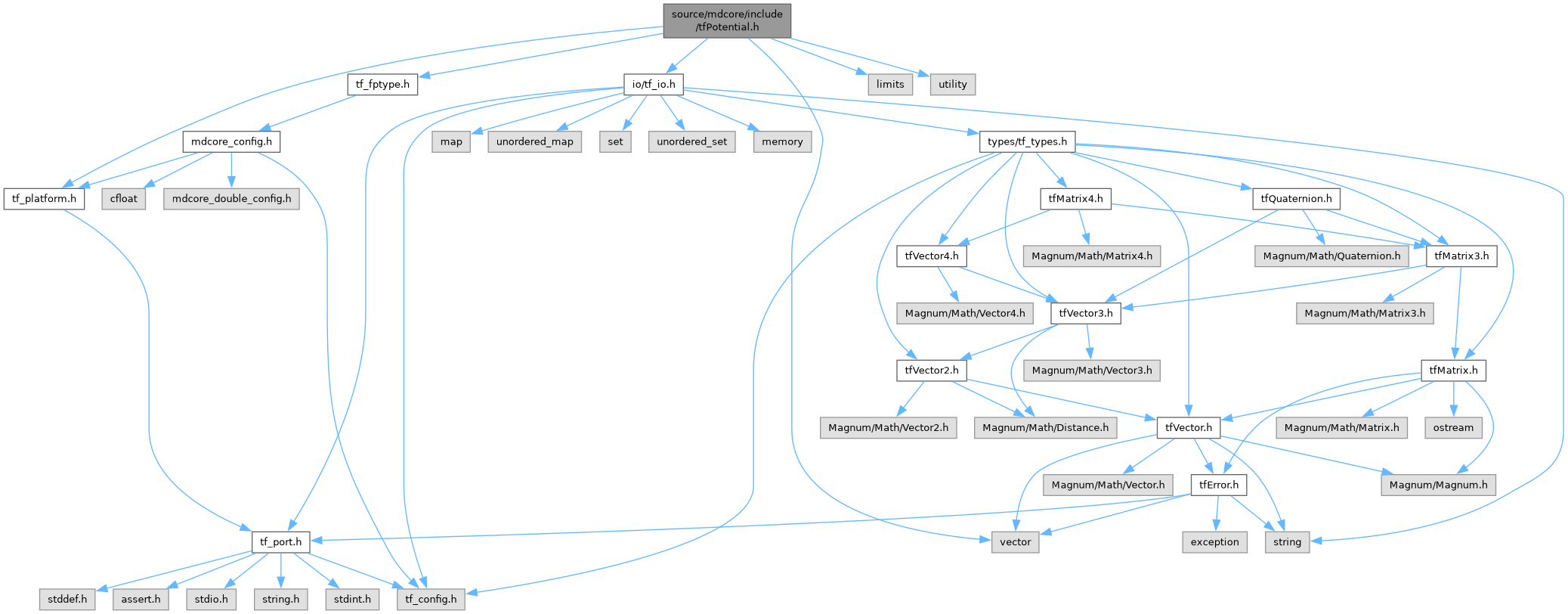
Include dependency graph for tfPotential.h:
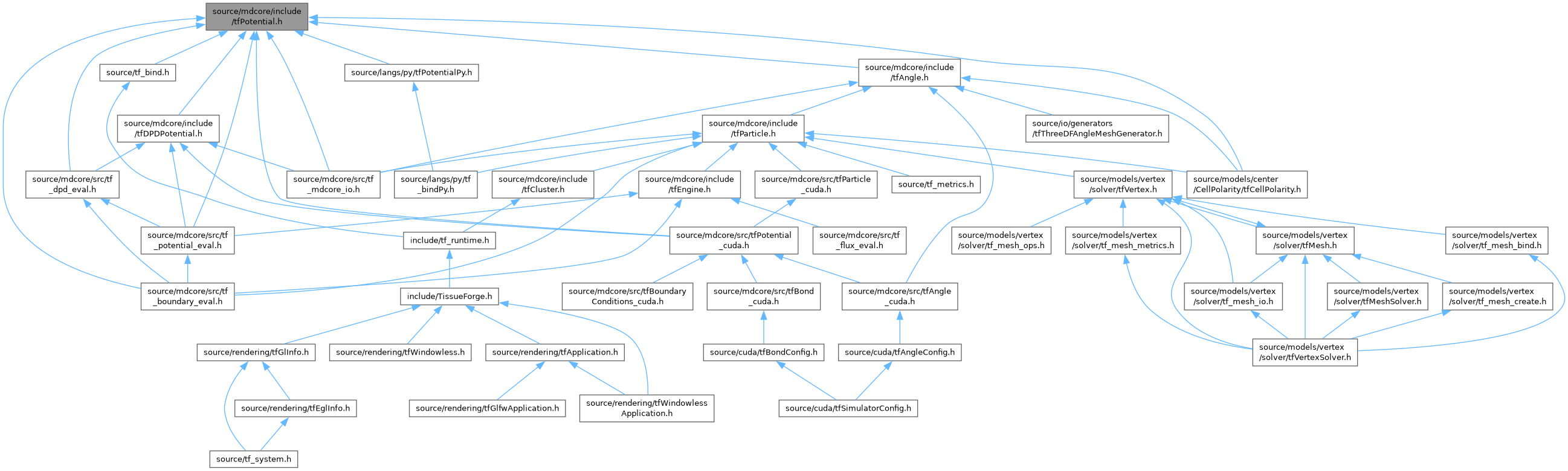
This graph shows which files directly or indirectly include this file:
Go to the source code of this file.
Classes | |
| struct | TissueForge::Potential |
| A Potential object is a compiled interpolation of a given function. The Universe applies potentials to particles to calculate the net force on them. More... | |
Namespaces | |
| namespace | TissueForge |
| Include Python header, disable linking to pythonX_d.lib on Windows in debug mode. | |
Typedefs | |
| typedef void(* | TissueForge::PotentialEval_ByParticle) (struct Potential *p, struct Particle *part_i, FPTYPE *dx, FPTYPE r2, FPTYPE *e, FPTYPE *f) |
| Potential function on a particle. | |
| typedef void(* | TissueForge::PotentialEval_ByParticles) (struct Potential *p, struct Particle *part_i, struct Particle *part_j, FPTYPE *dx, FPTYPE r2, FPTYPE *e, FPTYPE *f) |
| Pair potential function. | |
| typedef void(* | TissueForge::PotentialEval_ByParticles3) (struct Potential *p, struct Particle *part_i, struct Particle *part_j, struct Particle *part_k, FPTYPE ctheta, FPTYPE *e, FPTYPE *fi, FPTYPE *fk) |
| Like PotentialEval_ByParticles, but with three particles. | |
| typedef void(* | TissueForge::PotentialEval_ByParticles4) (struct Potential *p, struct Particle *part_i, struct Particle *part_j, struct Particle *part_k, struct Particle *part_l, FPTYPE cphi, FPTYPE *e, FPTYPE *fi, FPTYPE *fl) |
| Like PotentialEval_ByParticles, but with four particles. | |
| typedef struct Potential *(* | TissueForge::PotentialCreate) (struct Potential *partial_potential, struct ParticleType *a, struct ParticleType *b) |
| typedef void(* | TissueForge::PotentialClear) (struct Potential *p) |
| Callback issues when potential is cleared. | |
Enumerations | |
| enum | TissueForge::PotentialFlags { POTENTIAL_NONE = 0 , POTENTIAL_LJ126 = 1 << 0 , POTENTIAL_EWALD = 1 << 1 , POTENTIAL_COULOMB = 1 << 2 , POTENTIAL_SINGLE = 1 << 3 , TissueForge::POTENTIAL_R2 = 1 << 4 , TissueForge::POTENTIAL_R = 1 << 5 , TissueForge::POTENTIAL_ANGLE = 1 << 6 , TissueForge::POTENTIAL_HARMONIC = 1 << 7 , POTENTIAL_DIHEDRAL = 1 << 8 , TissueForge::POTENTIAL_SWITCH = 1 << 9 , POTENTIAL_REACTIVE = 1 << 10 , TissueForge::POTENTIAL_SCALED = 1 << 11 , TissueForge::POTENTIAL_SHIFTED = 1 << 12 , TissueForge::POTENTIAL_BOUND = 1 << 13 , POTENTIAL_SUM = 1 << 14 , TissueForge::POTENTIAL_PERIODIC = 1 << 15 , POTENTIAL_COULOMBR = 1 << 16 } |
| enum | PotentialKind { POTENTIAL_KIND_POTENTIAL , POTENTIAL_KIND_DPD , POTENTIAL_KIND_BYPARTICLES , POTENTIAL_KIND_COMBINATION } |
Functions | |
| void | TissueForge::potential_clear (struct Potential *p) |
| Free the memory associated with the given potential. | |
| HRESULT | TissueForge::potential_init (struct Potential *p, FPTYPE(*f)(FPTYPE), FPTYPE(*fp)(FPTYPE), FPTYPE(*f6p)(FPTYPE), FPTYPE a, FPTYPE b, FPTYPE tol) |
| Construct a #potential from the given function. | |
| HRESULT | TissueForge::potential_getcoeffs (FPTYPE(*f)(FPTYPE), FPTYPE(*fp)(FPTYPE), FPTYPE *xi, int n, FPTYPE *c, FPTYPE *err) |
| FPTYPE | TissueForge::potential_getalpha (FPTYPE(*f6p)(FPTYPE), FPTYPE a, FPTYPE b) |
Variables | |
| struct Potential | TissueForge::potential_null |
